“This specimen perfectly illustrates the cooperative evolution of plants and animals during this time period.”
David Dilcher et alAngimordella burmitinais a newly discovered ancient beetle species , found trammel inside fossilised amber .
While the meaning of pollination — and cross-pollinate insects — has become common knowledge , scientist have long struggled to estimate when the phenomenon of pollenation first begin on Earth . A popular guess used to be about 49 million years ago .
But scientists have found recent grounds that suggests pollenation of plants on Earth began much earlier than that . According toScience Magazine , an international squad of researchers from China and the United States uncovered a prehistoric beetle specimen trapped inside amber , and on that specimen were tiny eyeglasses of pollen .

David Dilcher et alAngimordella burmitinais a newly discovered ancient beetle species, found trapped inside fossilized amber.
Details of the team ’s findings aredescribed in a study release in the journalProceedings of the National Academy of Sciences .
Finding traces of pollen on a 99 - million - year - old insect might not voice like such a big muckle . But the discovery is a huge revelation for scientist , bear on back the forecast date of former insect pollination on Earth by at least 50 million years earlier than what was previously thought .
Not to mention the fact that a ossified specimen inside amber with pollen still stuck on its body is an strange find .

David Dilcher et alAn illustration of whatAngimordella burmitinamight have looked like 99 million years ago.
“ It ’s exceedingly uncommon to discover a specimen where both the insect and the pollen are preserved in a single fossil,”said David Dilcher , the study ’s atomic number 27 - author .
“ away from the implication as earliest known verbatim grounds of insect pollination of flower industrial plant , this specimen perfectly illustrates the cooperative evolution of plants and animals during this time period , during which a true exposition of flowering plant occurred . ”
David Dilcher et alAn illustration of whatAngimordella burmitinamight have looked like 99 million years ago .
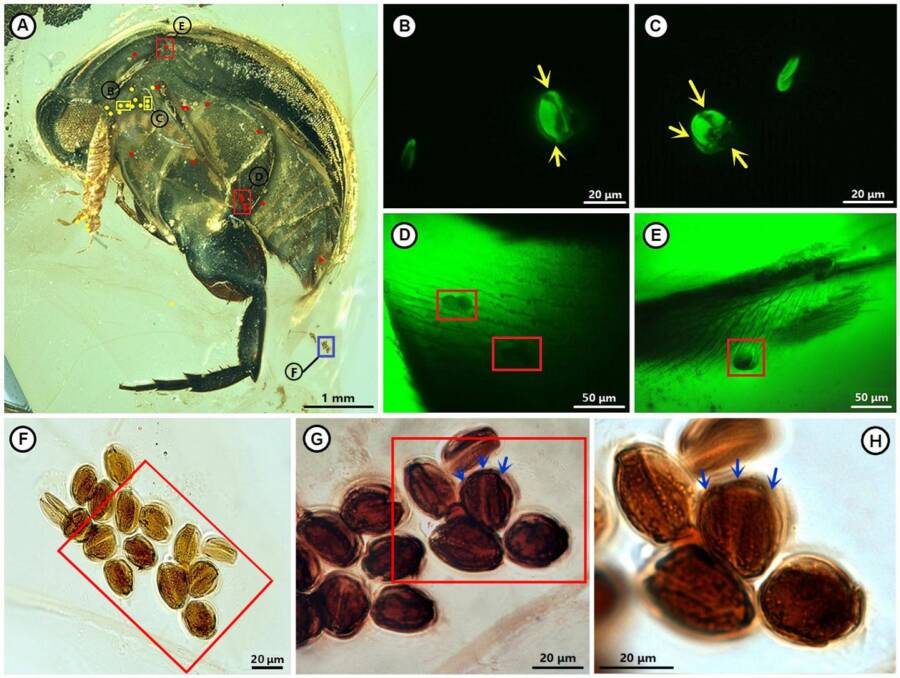
David Dilcher et alMicro scans of the tiny beetle and the grains of pollen found on its body.
First dig up in northern Myanmar by scientists in 2012 , the mallet specimen is a freshly let out species calledAngimordella burmitinaand is related to a mod species of blossom - make out beetles .
The species has a peculiar shape unlike the beetles we see today . In addition to being flyspeck — the specimen appraise about four millimeters long — theA. burmitinahas a curved - shaped body and head , which likely enabled it to strive deeply into the flush and provender on the sweet nectar .
TheA. burmitinais also embrace in fine hairs and has extremity near its sassing that expect and distributed pollen wherever it went , just like its modern - day relatives .
Researchers , lead by Wang Bo from the Nanjing Institute of Geology and Palaeontology of the Chinese Academy of Sciences , used various mellow - tech tools to examine the lilliputian bug and the 62 grains of pollen that cover the mallet ’s leg , abdomen , and thorax .
The squad used optical microscopy , confocal optical maser scan microscopy , and X - beam microcomputed imaging to disclose the micro details of the beetle and pollen . While researchers found it difficult to square up the accurate plant from which the pollen come from , they believe the flower grain came from flowering works of the eudicot mathematical group , which include many modern - twenty-four hours species of Sir Herbert Beerbohm Tree .
According to Dilcher , the pollen ’s size of it , clippety-clop , and “ ornamentation ” suggest the plant that get the pollen retrieve on the beetle acquire so that it could be dispersed through contact with dirt ball .
David Dilcher et alMicro scans of the tiny beetle and the grains of pollen bump on its organic structure .
“ This is the other direct grounds of insect pollination of angiosperms , ” the report noted , referring to the breed of plants that produce flowers and pollen . Angiosperms arise roughly 250 million long time ago , and they are the most divers group of country plant life with 300,000 bonk species .
Ancient fossil in Burmese gold have been a all important tool for scientists to unlock the mysteries of our Earth ’s past times .
Before the breakthrough , many scholars since Darwin — who called the rapid radiation experienced by flowering plant during the mid - Cretaceous clock time an “ abominable mystery ” — believed that worm pollination was likely the culprit behind the rapid radiation therapy full stop , since worm and flowering plant both subsist at the metre .
But without concrete grounds , this theory remained a mere idea — until now .
Now that you ’ve learned about the prehistorical pollen - compensate beetle , check out thisancient millepede fossilise in Burmese amberfor 99 million years . Then , take a look at thesegorgeous 100 - million - yr - old flowersthat were also perfectly preserved in amber .
