When you purchase through links on our internet site , we may earn an affiliate delegacy . Here ’s how it work .
The Rosetta space probe ’s " rubber ducky " comet seems probable to have emerge from a blue kiss in the cold black of out space . And the comet might have a secret to say about Neptune .
Comet 67P , where theEuropean Space Agency(ESA ) landed its Rosetta probe back in the summertime of 2016 , has a strange form . It is reasonably small , just about 2.5 international mile ( 4.1 kilometers ) at its spacious point , and consists of two bulging lobe connect together by a narrow neck opening . In an unpublished paper awaiting peer review that appeared in thepreprint daybook arXiv , stargazer detailed how the comet may have form and transmigrate into the orbit of Jupiter . And that history has important entailment for the early history of the solar system , in particular fortheplanet Neptune , the researchers said . [ Danger ! fall rock : Meteorites and Asteroids ( Infographic ) ]
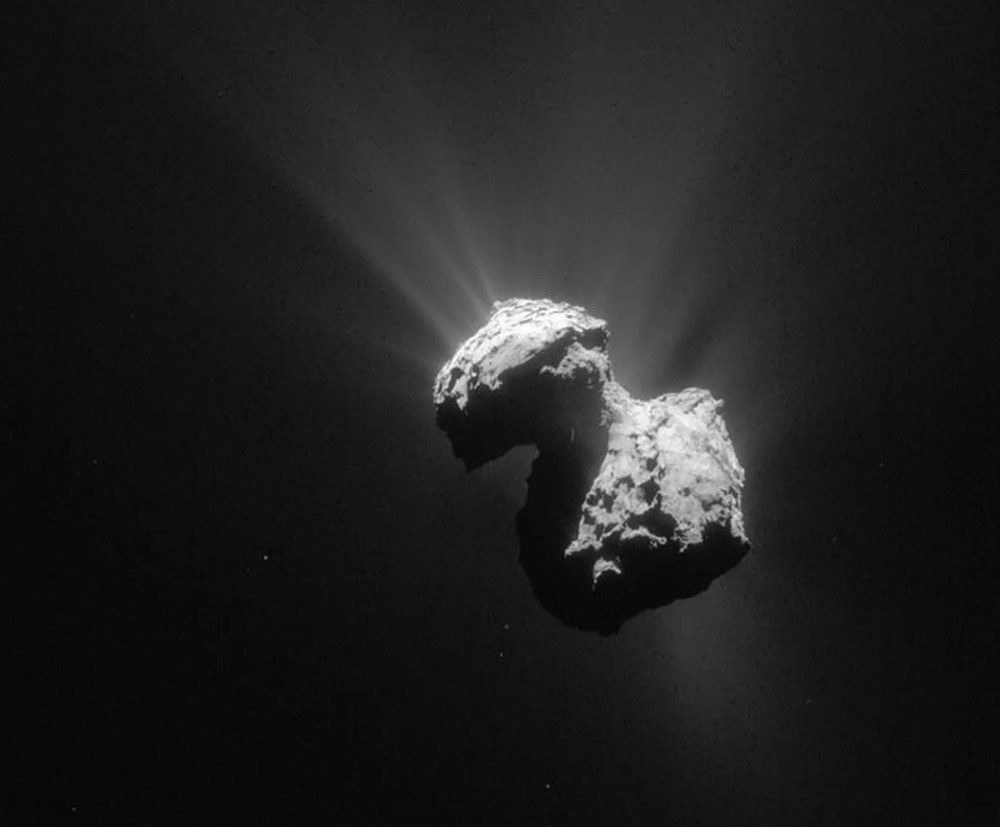
A single frame Rosetta navigation camera image of Comet 67P/Churyumov-Gerasimenko.
Astronomers do n’t have time machines ; they ca n’t travel to the yesteryear and see how 67P formed . But they can apply the information they do have about the comet and oursolar systemto good example the object ’s story . And that example has led to some absorbing conclusions about what the solar system looked like eons ago , when 67P likely formed .
Thesolar systemis a roil field of orbiting target , tugging on one another with gravity . So , there are limit to how on the button uranologist can track 67P backward through time . Researchers already knew that the comet pass on near Jupiter on Feb. 4 , 1959 , and Oct. 2 , 1923 . peer further into the past , though , is much more difficult , the scientists order .
But by modeling dozens of paths that could have pointed the comet to its current position , the investigator concluded that the object probably moved into the inner solar system more than 1,000 years ago . That was after it formed and spend eons orbiting the sun 20 to 30 times farther away than satellite Earth is locate , in agiant swarm of rubble .

But that flight get a problem , because unless 67P broke off from a larger comet , it almost certainly would n’t have survived the version of the other solar scheme that scientists have long suppose , the researchers in the new study said .
Most histories of the former solar arrangement have a disc of dust and junk revolve at 20 to 30 timesEarth ’s current distance from the sunlight . In this swarm of fabric , jillion of years ago , lilliputian clumps of dirt organize and banged into one another , sometimes clumping together into larger objects and sometimes falling apart .
In the most common adaptation of this story , that cloud lasted about 400 million long time . But the uranologist in the raw sketch institute that if that were truthful , 67P almost sure would n’t have pull through . Over all that metre , the comet would have smashed into other object and fallen aside , the researchers said .

So 67P ’s survival of the fittest bring acceptance to another hypothesis : Perhaps Neptune , which once orbit much closer to the sun , drift out through that disk of matter soon after the disc mold 4.5 billion years ago . Neptune ’s drifting could have cause the disk to disperse , saving 67P from collisions in the rough and tumble environment of the rubble disk that spawned the comet , the new study sound out .
If Neptune ’s mass absorbed or break up most of the rubble just 10 million years after the disk formed , that might explain how 67P survived to the present , the study said . Four - hundred million age ? mortal . But 10 million ? That ’s a unforesightful enough twain of clip spent in the dirt cloud for 67P to have survived inviolate , the researchers compose in their study .
Cosmic kiss
The stargazer did n’t pop the question a firm answer on how67Pitself was formed . It ’s potential , they write , that a mound of rubble just form in its current , galosh - duckyshape from the beginning , though there are reasons to doubt that hypothesis .
The two lobes could also have lead from two smaller comets orbit one another , called a binary , follow together , and there are two possibilities for how that might have happened , the study said . Maybe a tardily orbiting binary brush past a planet and got nudged into forming a single comet . Or maybe tinycollisions with other rockspushed the two lobes together until they met .
A coppice with a major planet pushing the binary star together , the research worker found , is improbable . Such a stuffy encounter with a planet would belike destruct most comets .

But maybe , out in that detritus cloud , pebbles bashed into the two orbit chunks of 67P over and over . Each of those collisions would have sapped a bit of energy from the binary orbit , slowing the orb chunks down , the written report sound out .
The art object would have already been go pretty slowly , the authors compose . The lightweight lobes of 67P would have orbited one another at just a few feet per secondly back then . As the chunks live hit , that speed would have deteriorate over time , until the pieces come together comparatively gently .
It seems very potential , then , that Rosetta ’s comet formed in this 1000000000 - of - eld - one-time osculation , the two lobes locking together and vagabond a long path through quad before arriving in a spot where man could get to out and touch them .

primitively published onLive Science .


