When you buy through links on our web site , we may earn an affiliate commission . Here ’s how it works .
Five scope made of osseous tissue and date to the eighteenth C have been discovered in Amsterdam , with two of the scopes found in the equivalent of john .
At the time , called the Enlightenment , the telescope would have been considered sumptuousness items and were probably used to stare at objects on land or ocean , rather than to look at the stars . They were create during a period when Amsterdam was a flourishing center for trade , one that attracted gifted craftsmen .
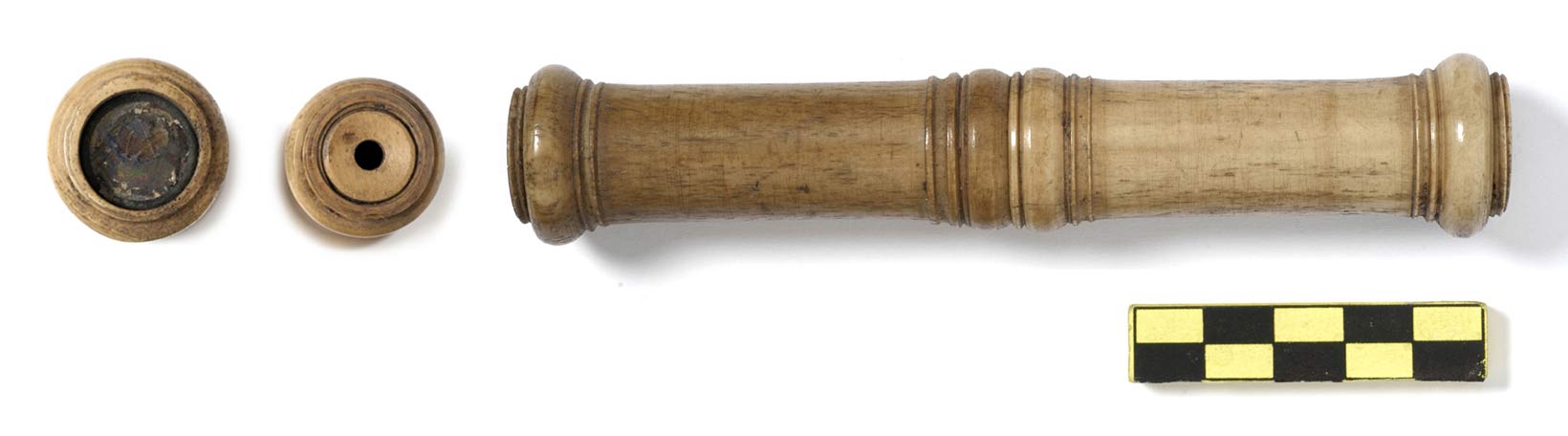
The longest of the telescopes discovered, about in. (140 mm) long and made of cow metatarsal bone, has two finely crafted parts held together with a screw thread. At far left, a lens of the telescope, next to a device with a hole that functioned as an aperture stop.
vagabond in length from roughly 3 to 5 inches ( 80 to 140 millimeters),the telescopeswere made using cattle metatarsal bone . " This finicky os of cow , the metatarsal off-white , is really quite straight and round , " Marloes Rijkelijkhuizen , of the Amsterdam Archaeological Centre at the University of Amsterdam , tell LiveScience . “It ’s a decent figure to make these telescopes from , it ’s straight and ( has a ) very round narrow cavity . "
Each telescope would have had a pair of lenses — like the scheme used byGalileo — a bulging objective and a concave ocular , to magnify objects . ( Two of the telescopes have at least one crystalline lens entire . ) The longest of the telescope , which had both lens intact , is made of two parts put together with a shag thread , and was equipped with a os insertion that has a small hole and likely functioned as an aperture stop . [ Quiz : The World ’s Greatest Inventions ]
With a blowup of about 3,the off-white telescopesmay have been used as opera glass , apply up by their loaded owners to get a good view of the degree . Another idea is that someone work to ocean , perhaps as a ship rider , toted these with them .

This finely crafted telescope, with a lens still intact, was found in a cesspit, a place used as a toilet in the 18th century. How it got there is a mystery.
The telescopes were excavated at different times over the retiring 40 years by the Office for Monuments and Archaeology in Amsterdam . item of the finding had n’t been publish until now , and , in the case of two of them , were unidentified until several years ago when Rijkelijkhuizen , then a schoolmaster ’s level bookman , started work on her thesis . She was looking at constitutional artifacts found in Amsterdam when she hail across bone artifacts that would subsequently turn out to be telescopes .
" At first I did n’t recognize them either , " Rijkelijkhuizensaid . Her analysis of the five telescopes is now published in the most recent edition of the Journal of Archaeology in the Low Countries .
find in a toilet

When Rijkelijkhuizenlooked over the mining reports she found that two of the telescope had been discovered in cesspool – the 18th - century equivalent of a stool . It ’s not clear where the other three telescopes would have been originally deposit in the 18th 100 .
" It ’s a sewer but it is also like a dump for trash , " she said . Why luxury item like these would have been put in toilets is a closed book ; perhaps they broke and their owners , despite the cost of producing them , throw them by . Another melodic theme is that their owners lost them . [ A Gallery of the World ’s Toilets ]
Rijkelijkhuizen said it ’s not the first time she ’s unveil strange object in pits like these . " We find all unlike form of objects in a cesspit , like false tooth , and we think ' why ? ' "

However it happened , it was fortunate for the archaeologists . " Because it was a bathroom , and it ’s a very smashed environment , all the aim in it are ordinarily very well preserved , " she say .
Ushering in the Enlightenment
The eighteenth century was a time of great change with new ideas , both scientific and political , being talk over . The telescope , with its power to let people gaze at the star , and see objects from a great distance , play a significant role in these changes . It had been invented only a century sooner . [ The History of Telescopes ]

" The scope ( and later the microscope ) , were thus two major gimmick that help usher in the enlightenment , " writes Geoff Andersen , an astronomer and source , in his book"The Telescope : Its History , Technology and Future " ( Princeton University Press , 2007 ) .
" Suddenly , anyone could experience things beyond the range of the unaided human sentience , and start questioningconventional wiseness about the universein which we live . "
Although these newly discover bone telescope were not the most powerful telescopes of their 24-hour interval , for their owners it would have given them the ability to peer out far into the horizon .


