When you buy through contact on our site , we may bring in an affiliate committee . Here ’s how it works .
A railway construction projection in fundamental London has turned up the skeletons of 13 victim of the Black Death .
The find is a reminder of how much history sit beneath urbanized orbit in the United Kingdom . In February , archaeologists in Leicester announced that they’ddiscovered the ivory of the lost monarch Richard IIIunderneath a urban center council parking lot . And this calendar week , archaeologist in Edinburgh uncovered thegrave of a medieval knighton the construction site of a novel building .
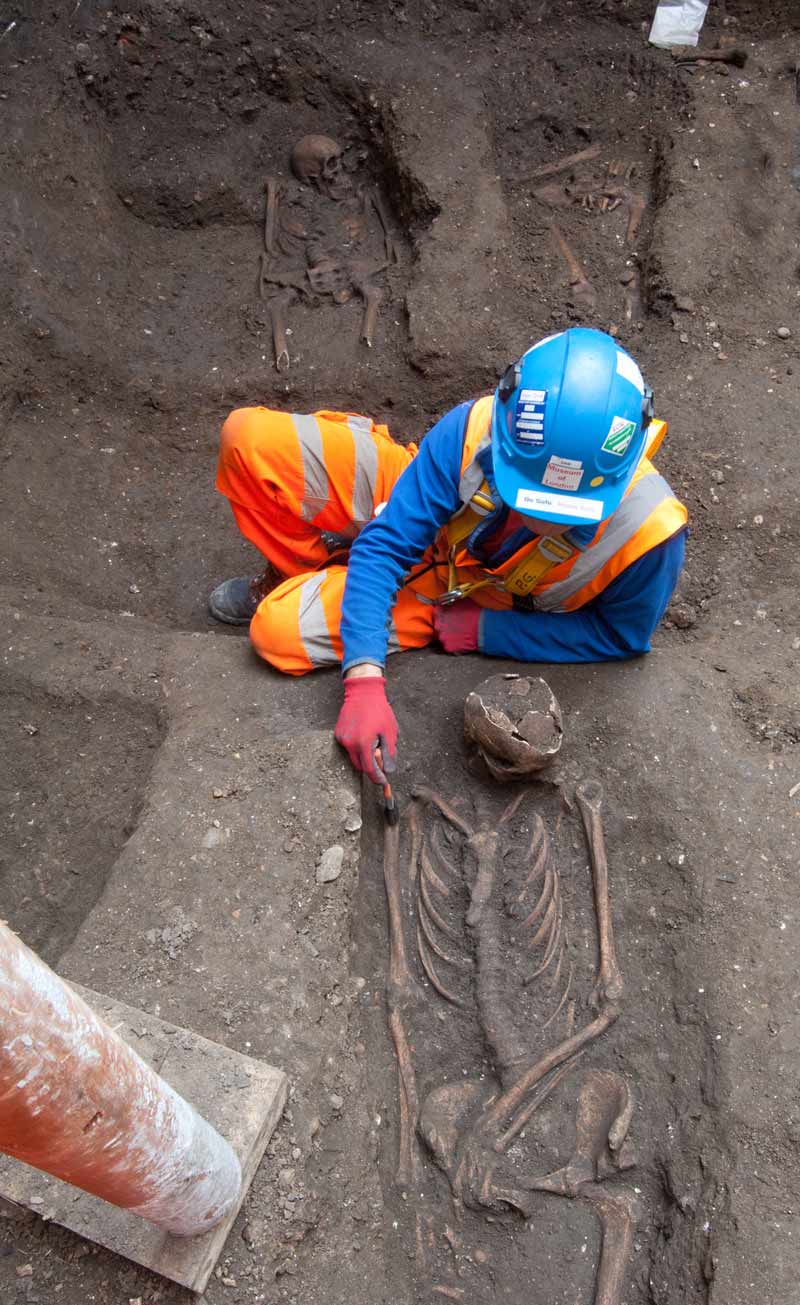
In addition to this recently unearthed 1348 Black Death burial ground (shown here), another one was discovered in the 1980s in east Smithfield, where more than 600 skeletons were removed for analyses.
The commuter train railway at the center of the current uncovering , call Crossrail , is under construction in southeast England . Archaeologists are consulting on the project to ensure that no historic artifacts or remains are ruin . In a dig near Charterhouse Square in the historic district of Farringdon , the research worker get hold two neat quarrel of 13 skeletons buried about 8 feet ( 2.5 meters ) below the road .
Black Death cemetery
The depth of the inhumation aggregate with clayware dating to 1350 find in the Robert Graves paint a picture that the skeletons belong to plague victims who die around 1349 . There are historical record referring to a Black Death burial earth that opened in 1348 in the domain , where as many as 50,000 people may have been hastily interred in less than three years . The burial ground see continued use until the 1500s , fit in to CrossRail . [ See pic of the ' Black Death ' Gravesites ]

The burial ground had been described as “no man’s land” in historical records referencing a burial in the Farrington area that opened during the Black Death plague in 1348.
The Black Death , or bubonic pestilence , was triggered by a bacterium ( Yersinia pestis)spread by fleas on rats . It top out in Europe in the mid-1300s , but killed an estimated 75 million masses over the course of the 14th century . dupe sported blacken , swollen lymph node called buboes , contracted intense fevers and vomit up blood , usually dying within days of contracting the disease .
No Man ’s ground
In the sixteenth century , historian John Snow wrote of aBlack Deathburial ground in Farringdon dubbed " No Man ’s Land . " Despite the exploitation of the area , no trace of this graveyard had been found until the Crossrail project began . Charterhouse Square , where the skeletons were found , was a prime positioning for where the cemetery might be , as it had n’t been developed in the past 700 years .

In 1998 , archaeologists explore for a historic chapel ascertain a unmarried skeleton in the square . And two age ago , Crossrail archaeologists incur antecedently - disturbed human bones . Both of those discoveries were twit clue that a large graveyard might be nearby .
archaeologist have pick out the excavated finger cymbals to the Museum of London Archaeology for testing , including DNA mental testing to key any remainingPlague bacteriaand radiocarbon testing on the bones to establish firm burial particular date . The scientists say there is no health risk from the Plague bacteria , as it ca n’t come through in the soil for farsighted ( rather they are looking for the dead bacteria ’s DNA ) .
The land site will be used as a prick to substantiate tunneling employment once the frame are removed and analyzed . Crossrail has also turned up skeletons near Bethlem Royal Hospital , advantageously known as Bedlam for its appalling consideration in the Middle Ages . Those underframe ( 300 of them ) dated back to the 1500s through 1700s .


